
Executive summary
- Inflation is expected to remain elevated. The Bank of Canada now forecasts inflation averaging about 3% in 2027.
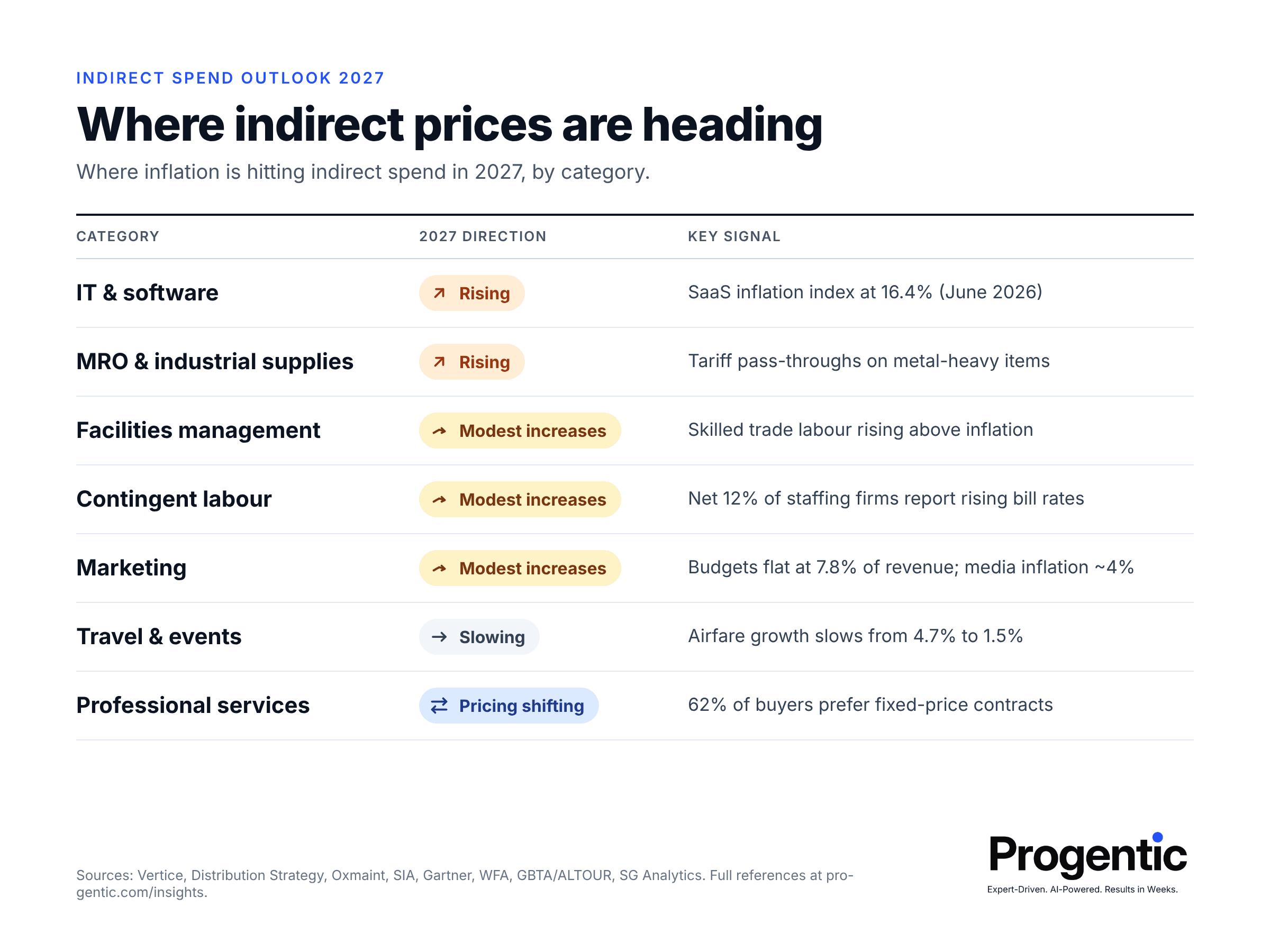
- Exposure varies widely by category. Software and MRO are rising well above the headline rate, labour-intensive services are rising modestly, and in professional services the change is in commercial models.
- Inflation can be offset, not only absorbed. Contract protections, demand and specification changes, and competitive sourcing reduce the impact.
- Spend visibility is the prerequisite. Category-level spend data is required to target these levers.
Headline inflation hides category exposure
The Bank of Canada raised its policy rate in October 2026 and now expects inflation to average about 3% in 2027, before returning to its 2% target in mid-20281. For CFOs, the more relevant question is how that pressure is distributed across the cost base.
Indirect spend is where it is least visible. It is spread across many suppliers and contracts, coded by GL account rather than category, and often renewed with limited challenge. Across the seven categories that typically account for most indirect spend, exposure to 2027 inflation differs materially, and so do the levers available to manage it.
Above-inflation pressure: software and MRO
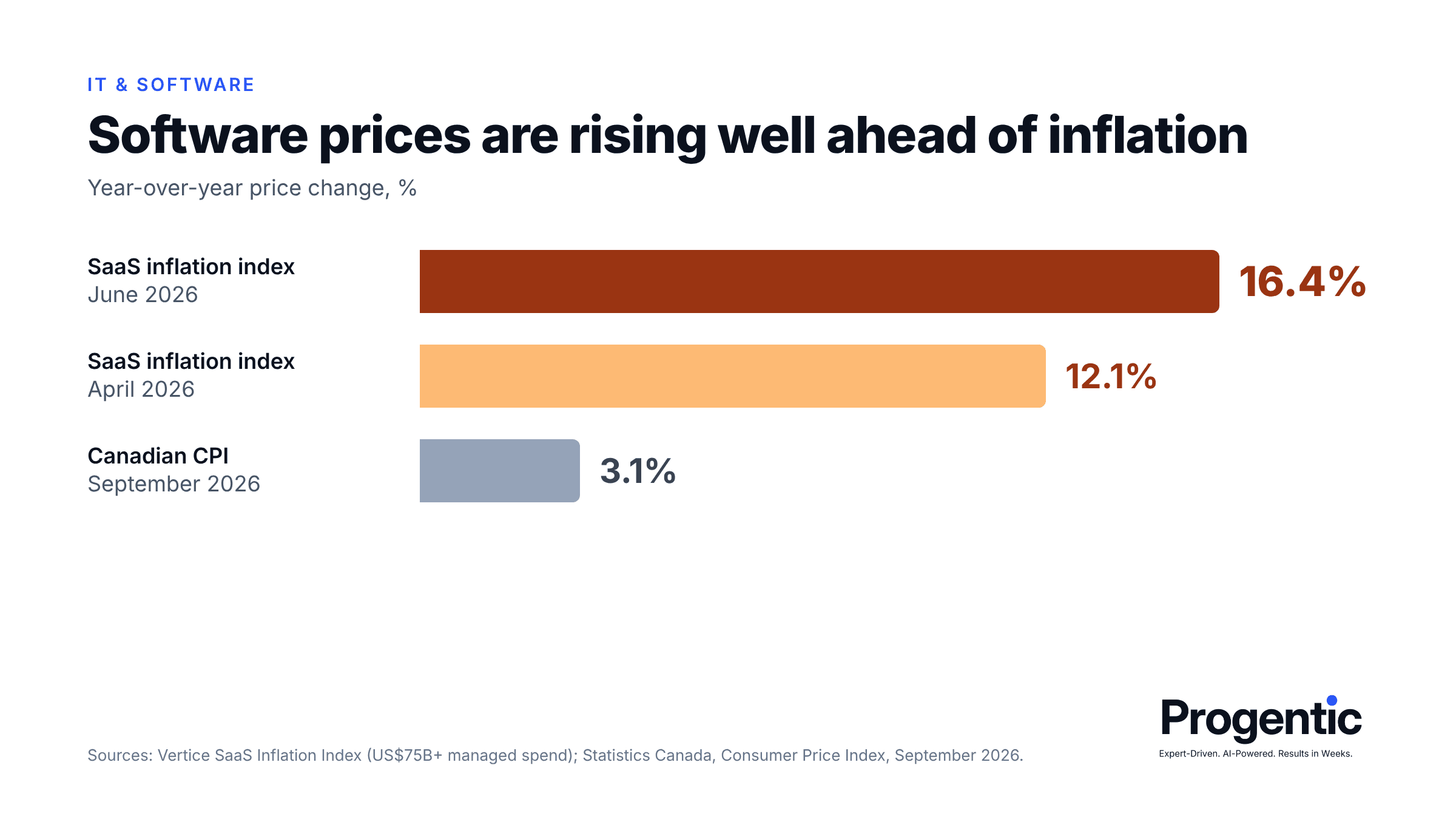
Software. SaaS price inflation reached 16.4% in June 20262, compared with Canadian CPI of 3.1% in September 20263. 79% of IT leaders report a price increase at their most recent renewal4.
The increases are largely driven by vendors bundling AI functionality into core subscriptions and repricing the full plan. Microsoft's commercial Microsoft 365 price changes, effective July 2026, affect most Canadian organizations5.
MRO and industrial supplies. Tariff costs continue to flow through distributor pricing. Metal-intensive items such as fasteners, valves, bearings and cutting tools are the most exposed to steel and aluminum tariffs6.
The pass-through is uneven. Distributors themselves report that supplier increases on branded tools and safety products are often difficult to substantiate, and are pushing back or substituting products7. Buyers should apply the same level of scrutiny.
Levers to manage it
- Build a renewal calendar for your top software vendors and negotiate the big ones together.
- Write CPI-linked caps on annual increases into contracts.
- Pay for AI add-ons only where people use them.
- Ask MRO suppliers to show the tariff cost behind each surcharge, and set an end date.
- Consolidate duplicate items and switch to lower-cost alternatives, such as generic brands.
Wage-driven increases: facilities, contingent labour and marketing
These categories are labour-intensive, so prices track wage growth rather than commodity markets. Individual increases are modest, but they compound across a large number of contracts that often receive limited oversight.
Facilities management. Skilled trade labour costs rose 3.9% in 2025 and remained above inflation into 20268. Cleaning, security and HVAC maintenance contracts generally follow the same trend.
Contingent labour. Bill rate pressure is increasing: a net 12% of staffing firms reported rising bill rates in September 20269. In Canada, contingent workforce rates have increased by approximately 1.8% a year since 202310.
Marketing. Budgets have held at 7.8% of revenue11, while media costs continue to rise by approximately 4% a year12, reducing effective purchasing power within an unchanged budget.
Levers to manage it
- Tie escalation clauses to a published wage index, not a flat rate the supplier proposes.
- Pay for results, such as response times, not hours on site.
- Review agency markups and contractors who have been in place for more than a year.
- Build one view of marketing spend across agencies, media, martech and print, and cut overlapping tools.
Moderating costs and changing commercial models: travel and professional services
Travel and events. Airfare growth is forecast to moderate from 4.7% in 2026 to 1.5% in 202713. This reflects slower increases rather than a decline, and 2027 rates are not expected to return to 2025 levels.
Professional services. The more significant change is in commercial models rather than rates. 62% of consulting buyers now prefer fixed-price contracts14, and buyers indicate a willingness to pay a premium for AI-enabled services where the improvement in outcomes is measurable15.
Levers to manage it
- Negotiate corporate hotel rates in your top cities this fall, before 2027 rate sheets are set.
- Budget travel from the forecast, not from 2025 actuals.
- Move repeat, well-defined professional services work to fixed fees.
- Agree up front how results will be measured on larger engagements.
Five levers to manage indirect cost inflation
- Spend visibility. Establish a category-level view of spend by supplier, so effort is directed at the categories with the highest exposure.
- Contract protection. Cap annual increases, link escalation clauses to a published index, and require cost support for any surcharge.
- Demand and specification. Remove unused licences and add-ons, consolidate duplicate items, and switch to lower-cost alternatives such as generic brands.
- Competitive sourcing. Rebid contracts approaching renewal and consolidate volume with fewer suppliers to strengthen negotiating position.
- Category-level budgeting. Plan 2027 costs by category rather than applying a single inflation assumption across the board.
Where Progentic can help
Progentic helps finance and procurement leaders offset cost inflation at each stage:
- Assessing inflation exposure. A Value Creation Excellence assessment quantifies where inflation is affecting indirect spend and the savings available to offset it.
- Offsetting supplier increases. Progentic's indirect spend management team leads sourcing and negotiations, from software renewals to MRO surcharges.
- Ongoing visibility. ProcureSense classifies spend and monitors market prices by category, flagging increases before they affect the budget.
Execution, not only recommendations. Progentic's procurement consulting team works alongside client teams to deliver the savings: renegotiating renewals, challenging surcharges, consolidating suppliers and rebidding contracts, so that 2027 cost increases are offset.
Fees aligned to results. Engagements can be structured around the value delivered:
- Contingency pricing: fees are linked to a share of the savings achieved.
- Guaranteed ROI: engagements are guaranteed to deliver a 10x+ return on fees.
- Fixed fees for well-defined scopes.
Explore procurement consulting
How ProcureSense supports this
Most AP data is coded by GL account rather than spend category, and the same supplier frequently appears under multiple names. This is also a constraint on AI adoption: only 11% of organizations report that their CPO is fully ready to use AI in procurement16.
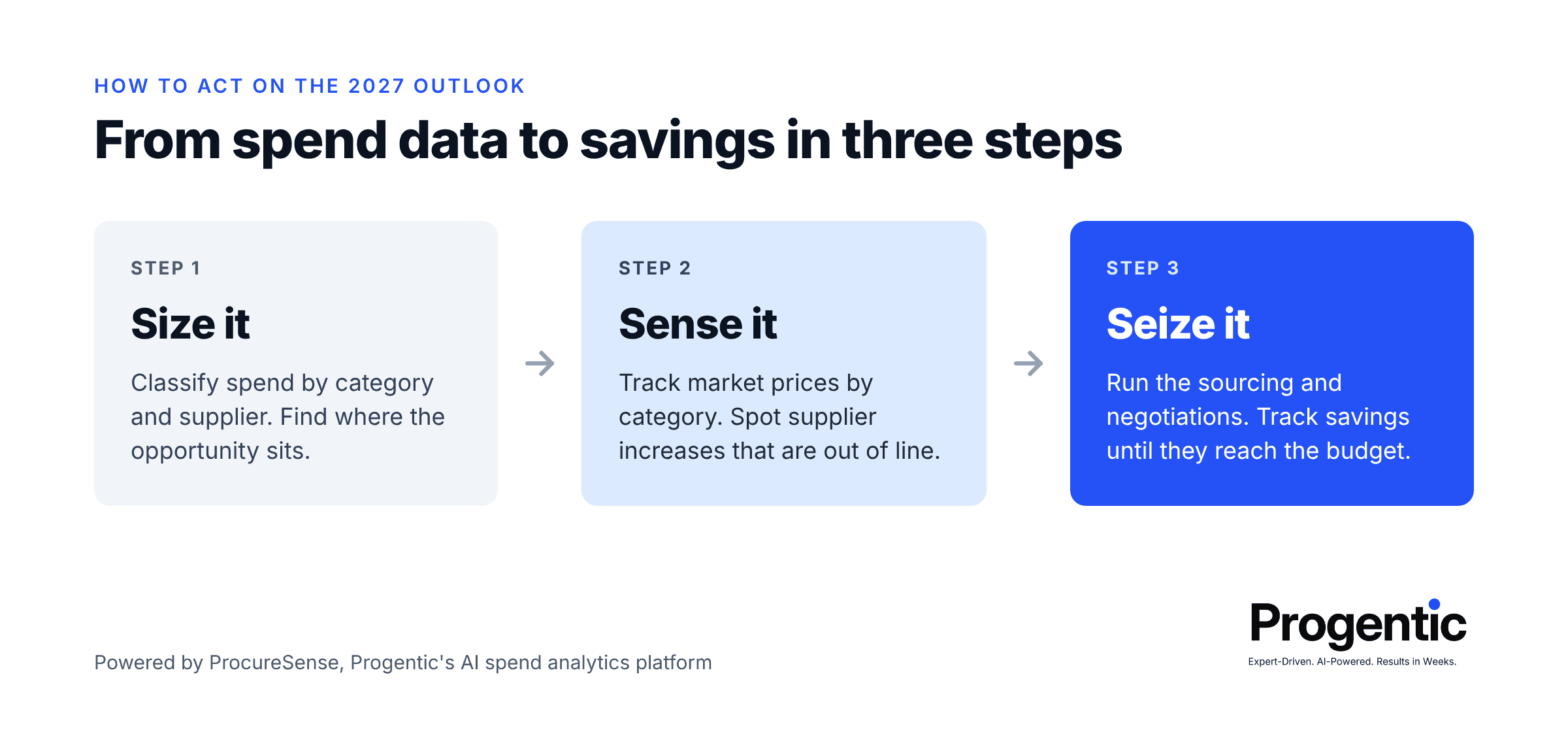
ProcureSense applies a three-step approach:
- Size it: classify spend by category and supplier, and find where the opportunity sits.
- Sense it: track market prices for each category, so out-of-line increases stand out.
- Seize it: run the sourcing and negotiations, and track savings until they reach the budget.
The takeaway
Inflation near 3% does not translate into a uniform 3% increase in indirect costs. Some categories will rise well above it; others can be held flat or reduced through contract, demand and sourcing levers.
Organizations that establish category-level spend visibility and act before contracts renew can offset a meaningful share of 2027 cost inflation rather than absorbing it.
- Bank of Canada, Monetary Policy Report, October 2026. https://www.desjardins.com/en/savings-investment/economic-studies/canada-boc-october-28-2026.html
- Vertice, SaaS Inflation Index, June 2026. https://brandsit.pl/?p=1998289
- Statistics Canada, Consumer Price Index, September 2026. https://www.wealthprofessional.ca/news/industry-news/canada-cpi-revealed/393806
- Zylo, 2026 SaaS Management Index. https://zylo.com/blog/saas-pricing-trends
- Microsoft 365 commercial pricing changes, July 2026. https://www.baytechconsulting.com/blog/saas-pricing-shift-negotiate-ai-driven-renewals
- Distribution Strategy, Tariffs and metals costs on MRO distributors. https://distributionstrategy.com/?p=10016
- Distribution Strategy, Tariffs squeeze distributors. https://archive.distributionstrategy.com/?p=8847
- Oxmaint, Facility management budget guide 2026. https://oxmaint.com/industries/facility-management/facility-management-budget-guide-2026
- Staffing Industry Analysts, US Staffing Industry Pulse, September 2026. https://www.staffingindustry.com/editorial/cws-30-contingent-workforce-strategies/provider-trends-contingent-labor-costs-rise-as-recruiting-gets-harder
- IBISWorld, Contingent Workforce Management Services in Canada. https://www.ibisworld.com/canada/procurement/contingent-workforce-management-services/80101513/
- Gartner, 2026 CMO Spend Survey. https://gartner.com/en/newsroom/press-releases/2026-05-11-gartner-2026-cmo-spend-survey-finds-cmos-allocate-15-point-3-percent-of-marketing-budgets-to-ai-but-only-30-percent-are-ready-to-scale-ai-capabilities
- WFA media inflation outlook. https://www.mediapost.com/publications/article/410016/advertising-media-cost-inflation-accelerates-this
- GBTA and ALTOUR, 2027 Global Business Travel Forecast. https://www.gbta.org/research/business-travel-forecast
- SG Analytics, Consulting services and outcome-linked pricing. https://www.sganalytics.com/whitepapers/us-consulting-services-enterprise-ai-outcome-pricing/
- IDC, AI's impact on pricing models for business consulting. https://cdn.idc.com/rss/rsspricingandvaluation.xml
- ProcureCon Insights, 2026 CPO Report. https://lifestyle.filmtelevisionauditions.com/story/6635/industry-study-cpos-are-taking-charge-of-ai-risk-and-growth-in-2026/